Sea level is rising:
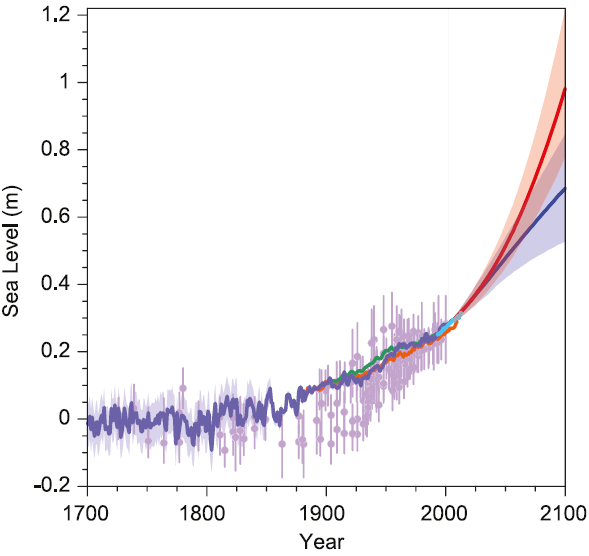
For the past, proxy data are shown in light purple and tide gauge data in blue. For the future, the IPCC projections for very high emissions (red, RCP8.5 scenario) and very low emissions (blue, RCP2.6 scenario) are shown. Source: RealClimate
Whilst it is true that much of this increase can be attributed to the thermal expansion of water and changes in land storage, the majority is due to glacial melt inputs from the Greenland ice sheet, Antarctica, mountain glaciers and ice caps.

Whilst it is true that much of this increase can be attributed to the thermal expansion of water and changes in land storage, the majority is due to glacial melt inputs from the Greenland ice sheet, Antarctica, mountain glaciers and ice caps.
Imagine how much water is in icebergs such as this one... And it's all destined for the oceans.
Rising sea level is evidently a worldwide issue - land masses all over the world will be encroached upon as water levels rise, thereby causing both flooding and also increasing the rate of coastal erosion. Additionally, many wetlands and the niche species of both flora and fauna associated with them will become endangered as water tables rise and salinisation occurs (Nicholls et al 1999, Nicholls 2004), posing a difficult problem for environmental agencies worldwide.
Salinisation is a serious problem as sea level rise is attributing to the loss of fresh ground water reserves (according to the Ghyben-Herzberg equation (e.g. Michael et al. 1999). This is an issue in several regards; first the brackish water can no longer be used for domestic use such as drinking and washing, second, the water is not usable for the irrigation of crops, and finally it affects the flora and fauna as mentioned above (Haque 2006).

Source: NewSecurityBeat
It's not only plants and animals under threat - humans have much to lose too. Take the examples of the Netherlands (50% of the land is less than 1m above sea level), and Bangladesh
where an estimated 10% of land would be lost if sea level were to rise by 1m. In the case of the Netherlands, sea level rise is likely to attribute to higher costs of maintaining the already highly expensive system of dykes and pumping stations. The expected costs to keep up with predicted sea level rise of 65-130cm by 2100 is 1 billion euros/year. Whilst this is certainly a major issue for the people of the Netherlands, it is most likely within their power to 'weather the storm' due to their superior existing infrastructure, relatively large economy and expertise with flood defence measures.

However, Bangladesh faces an entirely different problem. This country lacks the necessary resources to maintain, let alone construct a complex system of flood defences that will safeguard against future sea level rise. The country struggles to cope with current levels of flooding, with huge proportions of the country being annually inundated. Whilst it's true that much of this flooding is attributable to the major rivers that flow through the country such as the Ganges and the Brahmaputra, rising sea levels impacts the river gauge levels, thereby increasing the severity of fluvial flooding in addition to causing coastal flooding. It is also true that fluvial flooding has many benefits for the country, not least providing an incredibly fertile flood plain for agriculture. However, severe floods are becoming more and more prevalent with increasing sea level (and other anthropogenic effects such as deforestation, dams and urbanisation (Ives 1989)). In one particularly bad year (1998), 1300 people were killed, 7 million homes and 2 million tonnes of rice were destroyed, along with losses of other crops, the spread of diseases and millions made homeless (Chadwick et al.2001).
It's inevitable that sea level will continue to rise for the foreseeable future. However, the predictions of how much it will do so, are, after all, only predictions, and they vary in degree by large factors. Even the IPCC and academics cannot agree on how quickly the changes will happen, as there are so many variables involved, not least the rate of temperature increase which is a hornets nest in its own right. Hence, estimates tend to have huge error bars e.g. Rahmstorf 2006 which predicts sea level to be 0.5-1.4m above the 1990 level by 2100 - seems like he's hedging his bets a bit doesn't it...
As a result, the impacts of melting ice (and hence rising sea level) are also inherently hard to predict accurately, and therefore to prepare for. Despite this, it is undeniable that it is a problem now, and the severity of this problem is only set to increase over the coming century.
Salinisation is a serious problem as sea level rise is attributing to the loss of fresh ground water reserves (according to the Ghyben-Herzberg equation (e.g. Michael et al. 1999). This is an issue in several regards; first the brackish water can no longer be used for domestic use such as drinking and washing, second, the water is not usable for the irrigation of crops, and finally it affects the flora and fauna as mentioned above (Haque 2006).
Source: NewSecurityBeat
It's not only plants and animals under threat - humans have much to lose too. Take the examples of the Netherlands (50% of the land is less than 1m above sea level), and Bangladesh
where an estimated 10% of land would be lost if sea level were to rise by 1m. In the case of the Netherlands, sea level rise is likely to attribute to higher costs of maintaining the already highly expensive system of dykes and pumping stations. The expected costs to keep up with predicted sea level rise of 65-130cm by 2100 is 1 billion euros/year. Whilst this is certainly a major issue for the people of the Netherlands, it is most likely within their power to 'weather the storm' due to their superior existing infrastructure, relatively large economy and expertise with flood defence measures.
However, Bangladesh faces an entirely different problem. This country lacks the necessary resources to maintain, let alone construct a complex system of flood defences that will safeguard against future sea level rise. The country struggles to cope with current levels of flooding, with huge proportions of the country being annually inundated. Whilst it's true that much of this flooding is attributable to the major rivers that flow through the country such as the Ganges and the Brahmaputra, rising sea levels impacts the river gauge levels, thereby increasing the severity of fluvial flooding in addition to causing coastal flooding. It is also true that fluvial flooding has many benefits for the country, not least providing an incredibly fertile flood plain for agriculture. However, severe floods are becoming more and more prevalent with increasing sea level (and other anthropogenic effects such as deforestation, dams and urbanisation (Ives 1989)). In one particularly bad year (1998), 1300 people were killed, 7 million homes and 2 million tonnes of rice were destroyed, along with losses of other crops, the spread of diseases and millions made homeless (Chadwick et al.2001).
It's inevitable that sea level will continue to rise for the foreseeable future. However, the predictions of how much it will do so, are, after all, only predictions, and they vary in degree by large factors. Even the IPCC and academics cannot agree on how quickly the changes will happen, as there are so many variables involved, not least the rate of temperature increase which is a hornets nest in its own right. Hence, estimates tend to have huge error bars e.g. Rahmstorf 2006 which predicts sea level to be 0.5-1.4m above the 1990 level by 2100 - seems like he's hedging his bets a bit doesn't it...
As a result, the impacts of melting ice (and hence rising sea level) are also inherently hard to predict accurately, and therefore to prepare for. Despite this, it is undeniable that it is a problem now, and the severity of this problem is only set to increase over the coming century.

No comments:
Post a Comment