Sunday, 30 November 2014

The Perma-Problem (iii)

Over the past few posts, we've explored some of the negative impacts, both locally and globally of melting permafrost. This time round, I'm going to have a look to see if there might actually be some positives to come out of this process too.

Perhaps the most obvious example of a positive that can come out of this is how thawed out land, that was once covered in permafrost can often provide incredibly fertile land for agriculture. The rich organic soils that accumulated over 1000's of years provide an incredibly nutrient rich base for the planting of crops, especially vegetables such as potatoes and cabbages (which are naturally cold resistant). However, there is a serious drawback to 'reclaiming' thawed out permafrost areas. These areas often exhibit thermokarst (mounds and hollows in the landscape where the frozen earth meted at different rates) which evidently reduce the capacity for large scale arable farming due to the unevenness and irregularity of the soil surface. This can be countered by grading (levelling out) the landscape, but this process is both expensive, and labour intensive which decreases any potential benefits (Contributions to Alaskan Geology). 

A second potential benefit could be the harvesting of the previously mentioned methane clathrate, as according to the USGS, there is an estimated 700 000 trillion cubic feet of this substance (also known as methane hydrate) around the world, much of which is currently locked away under permafrost. This energy source has more potential energy than all discovered oil and gas reserves combined (Wall Street Journal). It must be noted that not all of these estimated reserves are found under permafrost, though the vast majority is/was formed under permafrost conditions. This is then combined with the extra ease of access to existing oil and gas reserves, as the costs of both extraction and transportation involved are much lower when the soil is unfrozen, as drilling and pipeline construction is easier.

Hydrocarbons are not the only natural resource that becomes easier to access with retreating and thinning permafrost - minerals are follow the same line. Sites upon which profits would have been marginal due to high extraction costs from the frozen soil become more economically viable once such soil thaws, as again, drilling and mining is easier in the softer soil horizons (Brown, 1970). One such example of this is the iron ore deposits in Labrador, Canada. Operations only became viable after the permafrost had thawed to such a depth that the previous increased costs of extraction were minimised to economically viable depths (Seguin, 1974). 

Monday, 24 November 2014

The Perma-Problem (ii)


So, melting permafrost poses us with problems. As already discussed, if one area melts, it's likely that other areas will soon follow due to the positive feedbacks associated with the release of carbon stores that had previously been locked up within the ground. However, further contributions to the greenhouse effect are not the only problem that is caused by the melting of frozen soil and rock.

A photo of trees falling over due to permafrost melting.
 'Drunken forests' as a result of melting permafrost. Fairbanks, Alaska, 2004. Source: National Geographic

Infrastructure is perhaps the best example of how humans and their livelihoods can be directly affected by this process.

Imagine that your house was built on frozen soil somewhere in the Alaskan taiga. Now imagine that the very ground upon which you are living begins to sink at differing rates as the ice thaws out. This is evidently a bit of a problem - your house and potentially your livelihood with it is could be doomed for collapse, at the very least forcing you to relocate, suffering the cost of building/buying a new home.


Source:BBC News (2004)

Doesn't look much fun does it?

Now, you would be right in thinking that this particular problem does not affect very many people - population densities are generally very low in such areas. However, it is not only buildings that are affected. Oil and gas pipelines and other necessary structures such as roads and power lines are also subject to damage from melting permafrost, and the failure of these structures can have much more wide-ranging impacts.


Collapsed road due to thawing permafrost. Source: landscapeonline


This poses further economic problems for the communities who live in such areas due to reparation costs, which in some cases will always be a losing battle. However, it is not only the very few people who live in the area who can be affected by this. Huge volumes of oil and gas are piped through such areas where it can be used to provide power, or any of the other plethora of functions to which hydrocarbons can be used; such as plastics and drugs to name but a couple of examples. If one of the major pipelines that moved oil or gas across Alaska (Trans-Alaska Pipeline System (TAPS)) or Siberia were to burst, then serious economic, and ecological problems would ensue as a result of the two separate factors: first; the lack of oil/gas at its intended destination, and second; the direct impacts on the area where the spill occurs.

A good example from the past of this happening was the Komi oil spill of 1994, where 160 000 tonnes of oil were spilled from a Lukoil pipeline due to a breach which was attributed to melting permafrost. This event marks one of the largest land spills in history. Surrounding wildlife and human health continues to be devastated by the effects (Catastophe Map), as there very few species which have survived the high toxicity of the soil, and cancer rates are through the roof.


Source: Oil Spill Solutions

Repairing pipeline damage and deformations due to melting permafrost costs the Russian oil and gas industry $1.8 billion/year (Greenpeace), with an estimated 35 000 pipeline accidents in Western Siberia alone according to the summary of the 2010 report. Evidently this has posed environmental, social and economic problems all in one go, and with the price of oil being as low as it is right now... how is Russia going to find the money to fix this mess?

All these problems are exacerbated by the continuing melting of permafrost which continues to cause severe disruption to economic, environmental and social welfare at many different scales. These problems are only set to increase as the extent and magnitude of permafrost losses become ever greater.


Monday, 17 November 2014

The Perma-Problem (i)


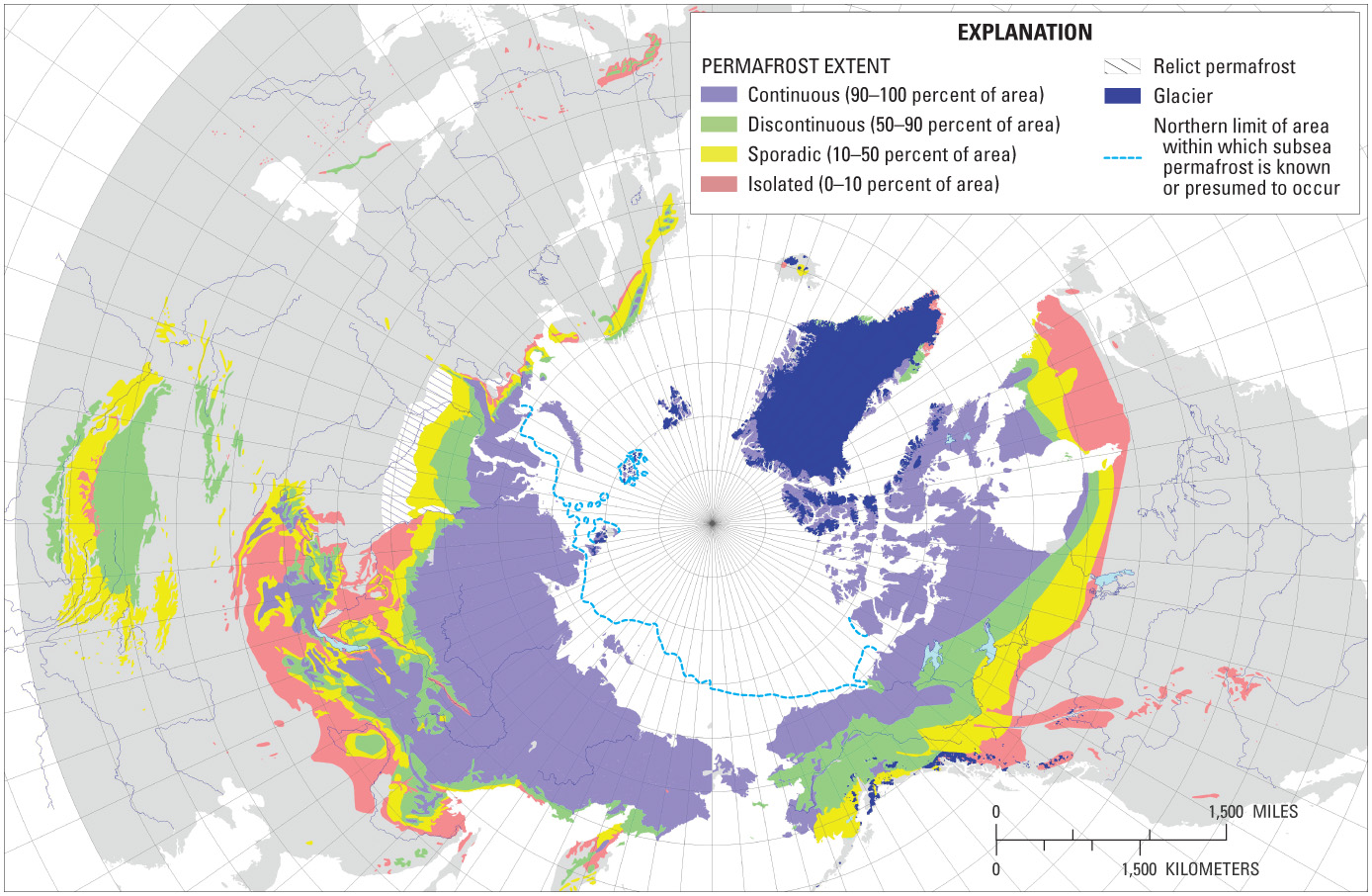
Much of the high latitudes is covered in permafrost - soil or rock that remains at or below 0°C for at least 2 consecutive years (International Permafrost Association). In the Northern Hemisphere, regions in which permafrost occurs, cover 25% of the land area (23 million square km), though much of this is sporadic coverage (See Fig. 1). The thickness and depth of the permafrost also varies hugely with space, as layers can be anything from 10cm to 1500m thick.

Fig. 1. Extent of Northern Hemisphere permafrost. Source: USGS

Why is this important? 

Permafrost is a major component in global carbon cycling, as it contains more than 1/3 of global organic carbon in soils (Wickland et al. 2005). As global temperatures increase, (and the poles warm at a much faster rate) huge swathes of permafrost degrade, thereby releasing the vast stores of carbon that they contain by way of carbon dioxide, methane and organic matter. This occurs because as the carbon rich frozen soils warm up, the organic matter  they contain (such as peat which has accumulated over many thousands of years)  becomes subject to bacterial decomposition. These bacteria feed on the organic peat soils as they thaw, as they have been prevented from doing so while the soil was frozen (perhaps for many thousands of years). In the process of decomposition, the bacteria release CO2 as they respire, in addition the the breakdown of the matter that is being decomposed. This is coupled with the fact that methanogenesis (producing methane) will have occurred while the soil was under anoxic (reducing) conditions. This CH4 is then emitted once the permafrost melts along with the CO2. Both CO2 and CH4 are potent greenhouse gasesthereby attributing to further warming, and hence further permafrost degradation. Evidently, this is yet another example of a positive climatic feedback. Wickland et al. 2005 estimate that the formation of thermokarst wetlands as a result of warming (as opposed to continuous permafrost) results in 13 fold increase in the volume of methane produced (and emitted to the atmosphere) over a given area. 

An important point to note is that not all permafrost is on land. The East-Siberian Arctic Shelf (ESAS) covers more than 2 million square km of seafloor in the Arctic ocean, making it 3 times the size of the Siberian wetlands, which were previously thought to be the primary source of Northern Hemisphere atmospheric methane (National Science Foundation) (See Fig 2). The permafrost is a relic of previous glaciations, when sea level was lower and the peat producing landscapes of Siberia extended many hundreds of kilometres into what is now called the Laptev sea. The prolonged cold of the glaciations led to incredibly deep formation of permafrost, often over 1000m deep.However, after the onset of the Holocene, the permafrost has gradually been melting due to the increased temperatures (and higher sea levels).

Fig. 2. Source: Climate Progress

 Shakhova et al. 200720102014 estimate that the ESAS is already releasing upwards of 1.1 teragrams of methane yearly, which is the same quantity as the rest of the ocean. This figure is only set to rise as the permafrost destabilises. Plumes of methane gas more than 1km wide have already been located. As the surface layer of the frozen ground thaws, it no longer forms a protective barrier which prevents escape of the gas. As methane is 30 times more potent as a greenhouse gas than carbon dioxide, this is particular example is potentially of huge global significance, because if the ESAS continue to melt at the current rate, then a large scale release of methane is all but inevitable. 

A further point is that much of the methane stored in the ESAS is not in a gaseous state, but solid - methane clathrate. This substance in inherently unstable and is prone to becoming a gas very readily, especially as it is warmed up. This means that large build ups of highly pressurised methane gas form beneath the hard surface layer of the permafrost of the sea floor. As this hard, containing crust itself melts, the chance of a large scale 'blow out' increases dramatically as the pressurised gas seeks to rise upwards due to its low density. Shakhova says: “Our concern is that the sub-sea permafrost has been showing signs of destabilization already,” she said. “If it further destabilizes, the methane emissions may not be teragrams, it would be significantly larger” (National Science Foundation). This could potentially lead to a scenario such as that proposed by the Clathrate Gun Hypothesis, though this is now thought to be unlikely. Despite this, the basic principle of the methane emissions reinforcing the positive feedback loop remains. 

So, melting permafrost is evidently a significant problem and one that I think should be monitored much more closely and given more public attention - it's remarkable how little literature there is regarding the topic in comparison to other similarly important topics such as sea-ice extent or impacts on wildlife. Whilst the problems discussed are unquestionably important, they are not extensive - next time I'll talk about some of the other impacts of melting permafrost such as its effects on infrastructure.

Saturday, 8 November 2014

Rising Tides

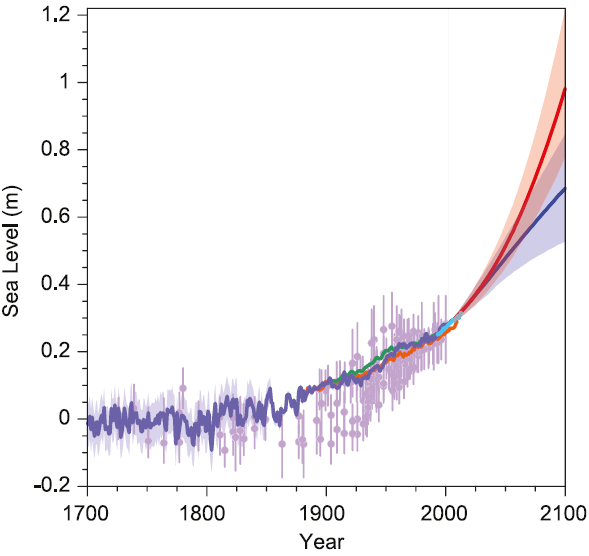
Sea level is rising:

IPCC_AR5_13.27
For the past, proxy data are shown in light purple and tide gauge data in blue. For the future, the IPCC projections for very high emissions (red, RCP8.5 scenario) and very low emissions (blue, RCP2.6 scenario) are shown. Source: RealClimate

Whilst it is true that much of this increase can be attributed to the thermal expansion of water and changes in land storage, the majority is due to glacial melt inputs from the Greenland ice sheet, Antarctica, mountain glaciers and ice caps.


Imagine how much water is in icebergs such as this one... And it's all destined for the oceans.

Rising sea level is evidently a worldwide issue - land masses all over the world will be encroached upon as water levels rise, thereby causing both flooding and also increasing the rate of coastal erosion. Additionally, many wetlands and the niche species of both flora and fauna associated with them will become endangered as water tables rise and salinisation occurs (Nicholls et al 1999Nicholls 2004), posing a difficult problem for environmental agencies worldwide.

Salinisation is a serious problem as sea level rise is attributing to the loss of fresh ground water reserves (according to the Ghyben-Herzberg equation (e.g. Michael et al. 1999). This is an issue in several regards; first the brackish water can no longer be used for domestic use such as drinking and washing, second, the water is not usable for the irrigation of crops, and finally it affects the flora and fauna as mentioned above (Haque 2006).


Source: NewSecurityBeat

It's not only plants and animals under threat - humans have much to lose too. Take the examples of the Netherlands (50% of the land is less than 1m above sea level), and Bangladesh
where an estimated 10% of land would be lost if sea level were to rise by 1m. In the case of the Netherlands, sea level rise is likely to attribute to higher costs of maintaining the already highly expensive system of dykes and pumping stations. The expected costs to keep up with predicted sea level rise of 65-130cm by 2100 is 1 billion euros/year. Whilst this is certainly a major issue for the people of the Netherlands, it is most likely within their power to 'weather the storm' due to their superior existing infrastructure, relatively large economy and expertise with flood defence measures.


However, Bangladesh faces an entirely different problem. This country lacks the necessary resources to maintain, let alone construct a complex system of flood defences that will safeguard against future sea level rise. The country struggles to cope with current levels of flooding, with huge proportions of the country being annually inundated. Whilst it's true that much of this flooding is attributable to the major rivers that flow through the country such as the Ganges and the Brahmaputra, rising sea levels impacts the river gauge levels, thereby increasing the severity of fluvial flooding in addition to causing coastal flooding. It is also true that fluvial flooding has many benefits for the country, not least providing an incredibly fertile flood plain for agriculture. However, severe floods are becoming more and more prevalent with increasing sea level (and other anthropogenic effects such as deforestation, dams and urbanisation (Ives 1989)). In one particularly bad year (1998), 1300 people were killed, 7 million homes and 2 million tonnes of rice were destroyed, along with losses of other crops, the spread of diseases and millions made homeless (Chadwick et al.2001).

It's inevitable that sea level will continue to rise for the foreseeable future. However, the predictions of how much it will do so, are, after all, only predictions, and they vary in degree by large factors. Even the IPCC and academics cannot agree on how quickly the changes will happen, as there are so many variables involved, not least the rate of temperature increase which is a hornets nest in its own right. Hence, estimates tend to have huge error bars e.g. Rahmstorf 2006 which predicts sea level to be 0.5-1.4m above the 1990 level by 2100 - seems like he's hedging his bets a bit doesn't it...

As a result, the impacts of melting ice (and hence rising sea level) are also inherently hard to predict accurately, and therefore to prepare for. Despite this, it is undeniable that it is a problem now, and the severity of this problem is only set to increase over the coming century.