Monday, 27 October 2014

On Reflection

Sea ice is melting. Year on year, average sea ice extent is decreasing.

global sea ice extent
Source: NSIDC

This fact is of huge importance, not only on local scales, but much more importantly on a global scale. 

As sea ice becomes less extensive, once-white areas turn into dark ocean waters. This has a dramatic impact on global albedo - the amount of solar energy that is reflected back into space. Oceans have a low albedo of roughly 20%, whilst thick, uncovered sea ice is roughly 50-70% (National Snow and Ice Data Centre). Hence, as the ice extent diminishes, heat energy is no longer bounced away, but is absorbed in the oceans. It's also important to note that it's not just total ice extent that is diminishing, but the total thickness of the ice. This is influential too, as thicker ice has a higher albedo than thin ice. This drives a vicious positive feedback cycle, as the oceans warm, causing additional sea ice loss.

This decreasing albedo boosts the rate of climate change.  Pistone et al., 2014 describe the decrease in albedo as 'equivalent to 25% of the average global warming currently occurring due to increased CO2 levels'.

So it's not just this guy who's affected -


It's all of us.

Sunday, 19 October 2014

Melting Point

So, how much evidence is there for melting ice masses?

Masses. (excuse the pun...)

Scientific publications, photos, model outputs, local accounts, historical archives... The list goes on.

Source: NOAA

The figure above shows modelled Northern Hemisphere mean temperature from a variety of different sources over the past 1200 years (adjusted to the same mean 1500-1899). Whilst they differ significantly at times, especially with regard to the magnitude of change, they broadly agree that temperatures are on the rise.

It's important to note that temperature change is much greater in the higher latitudes than the lower ones, which coincides with where most of the globe's ice masses lie...

This increase in temperature is affecting global ice balance in a big way:

 Source: DailyGalaxy

Abram et al. 2013 describe how summer ice on the Antarctic peninsula is melting at a faster rate than at any point in the last 1000 years. This is due to higher proportions of annual snowfall melting before becoming incorporated into the ice pack due to elevated temperatures.

Source: Skeptical Science, Velicogna 2009

The Greenland ice sheet is also experiencing unprecedented levels of melt:

Source: Skeptical Science, Velicogna 2009

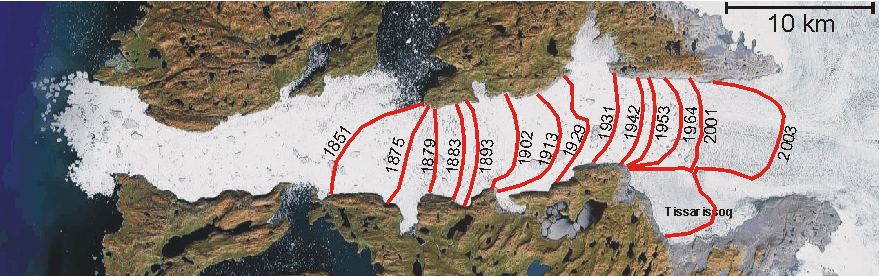
Jacobshavn Isbræ glacier retreat, Ilulissat, Western Greenland. Source: Climate4you

My Dad and I at the Jacobshavn Isbræ glacier icefjord, Ilulissat,Western Greenland, 2010.

Fun fact: this is the most productive glacier in the Northern Hemisphere, flowing at 20-35m/day. Icebergs up to 1km high calve here! It's also probable that the iceberg that sank the Titanic originated from this glacier - it's also a UNESCO World Heritage Site. 

It's simply stunning - one of the best natural phenomena I have ever seen (or heard... icebergs explode with echoing booms as pressurised air beneath the surface is released when they calve), and the thought that it's melting and diminishing in size year on year is an upsetting one.

Overall then, there's a plethora of evidence to say that ice; regardless of it's location or type, is melting.


Thursday, 16 October 2014

The Problem


Heat melts ice. Regardless of the location or exact form of that ice, be it the Arctic sea ice, or the Mer de Glace glacier in the French Alps, it melts when exposed to heat. 

The constant melting and accumulation of ice masses is an ageless process. However, recent climate has shown a trend of warming, and this trend is broadly accepted to continue (and accelerate?!) into the future. (Marcott et al., 2013IPCC 2013)

This presents us with a problem: more heat will lead to less ice. 

Over the coming 3 months, I'll talk about the impacts both locally and globally, on humans, animals and our environment of this decrease in ice. Will these impacts be negative as is generally assumed? Might there be some positives on the flip side? Or maybe it's a combination of good and bad?

We will see.