Monday, 12 January 2015

Bring on the ice!

Over the past few months, we've had a look at some of the impacts of the disappearing cryosphere. The effects are wide ranging, affecting people, habitats and climate not only on regional scales, but also on a global scale.

I think it's true to say that the bulk of the issues discussed are negative. Amongst the most important of these problems are the loss of albedo associated with the decrease in sea ice extent, the rise in sea level due to the loss of ice sheet mass and the impacts on wildlife which depend on cold conditions. It must also be stressed that the problems we've encountered are only set to increase as global climates continue to warm, thereby fuelling additional ice mass loss.

However, we've also seen that there may be some silver linings. namely improved opportunities for resource extraction and the possibility of improving the efficiency of global trade networks. 

But can we really view opportunities for getting more oil and gas as a positive? Isn't this part of the cause of the loss of ice masses in the first place? 

Yes, we are dependent on hydrocarbons, and no one would say no to a few more diamonds or rare earth minerals, but in our haste to get at them we may destroy some of the only truly pristine environments left on the planet. In procuring more hydrocarbons, we are only accelerating the rate at which global climates warm up.

Over and above the negatives that arise as a result of ice loss, I feel that glaciers, ice sheets and the like all hold an intrinsic value that cannot be overestimated. 


How strange would it be to think that there's no ice in the Alps or at the North Pole?

Monday, 5 January 2015

Ice Passages

As sea ice extent declines, it's possible that significant changes to how the world's trade route system operates will occur. New trade routes across the Arctic will become viable, shorter alternatives to the currently existing routes that involve the Suez and Panama canals. 

maps

The Northwest passage is 7000km shorter than the route through the Panama Canal, and the Northern Sea route is roughly 1/3 of the distance of the route through the Suez Canal. This decrease in distance and also shipping time will increase the efficiency of trade, by reducing costs significantly, thereby leading to additional growth for all parties directly or even indirectly involved in the trade. Furthermore, the risk of pirates in these passages is much lower than the traditional routes, thereby lowering insurance costs. 

Follow this link to have a look at some more of the savings that can be made:

It's only been a fairly recent assumption that it will be at all possible to successfully navigate either of these routes. Pharand (2006) states that 'international shipping in the Northwest Passage is a virtual certainty in the foreseeable future.' This claim was based on the fact that sea ice extent was at the lowest ever recorded level in 2006, and again (though not recorded by Pharand) in 2007 (Stroeve et al. 2007). As to the Northern Passage, Russia has only recently encouraged international traffic to use the route, as sea ice has until recently been too thick and extensive to navigate through, even with the use of ice breakers. 

Despite this, there are several shortcomings with such routes. For one thing, Canada and Russia claim sovereignty over the Northwest and Northern Passages respectively, thereby potentially being able to put a toll on using the waters in the event of them being used for international shipping (Byers and Lalonde 2009). Additionally, there are concerns about the viability of parts of the Northwest Passage for large container ships, as it is feared that parts of the channel may not be deep enough (Pharand and Legault 1984), though these claims have not been verified as full bathymetric surveys have not been completed .  It's also true that if a ship were to get in trouble, it would be much more difficult to get aid to that ship in the Arctic than it would have been if it had used one of the more traditional shipping lanes. 

Furthermore, whilst the passages may be ice free at the end of summer, that is certainly not the case in winter, when they are firmly frozen. Hence, any potential gains from using the passages will be entirely seasonal, and if there's a particularly cool summer, then the routes may not be viable for whole years at a time. As a result, shipping companies will be reluctant to put much reliance upon these routes for the foreseeable future. 

Despite these problems, with ice extent declining almost every year, it's entirely likely that we will see more and more shipping through the Arctic Passages, thereby improving the efficiency of global trade.

Tuesday, 30 December 2014

Resource Opportunity?

As ice masses retreat all over the world, is it possible that availability of some of the scarcest, most valuable resources on the planet will increase?

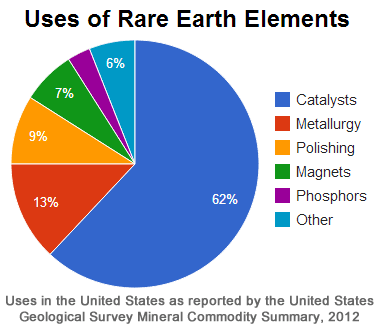
Take the example of rare earth elements (REE). China currently enjoys a near complete monopoly on such elements, controlling 85-95% of the supply (Forbes). The uses for these metals is endless, and demand is only set to increase. 

They are necessary in the construction of everyday objects such as batteries, phones, DVD's, but also as catalysts for industrial scale manufacturing. As society tries to move away from internal combustion, batteries and the like are only going to get more important to us. 

However, they're called 'Rare' earth elements for a reason. There just isn't all that much of them around.

Now, Greenland is one of the most resource laden islands on the planet. Along with diamonds, gold, uranium, hydrocarbons and many other natural resources, Greenland has a particularly large abundancy of these REE's. The only problem is that lots of them are buried under ice.

Not for long.

Estimates suggest that Greenland will soon produce upwards of to 20% of global REE supply (Foreign Affairs), mainly due to a single (ice free) mining site in Southern Greenland, near Narsarsuaq. 

As we've previously seen, the Greenlandic ice sheet is retreating, thereby uncovering more and more of these potential deposits. This isn't only a boon for you and me as it aids supply of our electronics for the foreseeable future, but also for the Greenlandic people, who will hopefully be able to gain their independence from Denmark with the considerable proceeds from all this mineral wealth. This dependence of Denmark is due to the fact that they are reliant upon Danish subsidies, imports and exports (Denmark accounts for 60 and 65% of total Greelandic imports and exports respectively). When Greenland can make enough revenue to make these subsidies obsolete, the their wishes of independence are far more likely to be realised.

Examples such as this can be found all over the world where ice exists: Melting permafrost aids with natural gas extraction, and several mining companies are exploring the possibilities of mining in Antarctic shelf (no extractions are yet taking place), to name but two examples. This is interesting because it's an example of how melting ice might actually be considered a positive rather than a negative one, a point of view which is rare!

Tuesday, 23 December 2014

Changing Weather Patterns

A topic that hasn't been mentioned yet is the potential impacts upon weather patterns across the world as a result of ice loss. This video, whilst basic provides a good summary of some of the potential impacts associated with ice loss in the Arctic, particularly towards the end of the clip.


Friday, 19 December 2014

Glacial Decline (ii)


Many areas of the world are partially or even wholly dependent on glacial melt for their water sources, especially during the dry season. However, it's not just a problem of shortages of water - exacerbated flooding is also a common symptom of the worlds melting glaciers. This is as a result of the fact that in the absence of glaciers, precipitation is not stored in the high altitude areas as ice and snow, but is discharged rapidly downstream, thereby causing the floods. 

An example of this in the Himalayas, and the surrounding countries. The glaciers there are sometimes termed as Earth's 'Third Pole' due to their magnitude in terms of the volumes of fresh water stored there (Climate etc). Almost 1/3 of global population is at least in part affected by glacial melt water of the Himalayas. Immerzeel et al. 2013 suggest that overall discharge is expected to increase at least until 2100 due to losses in the mass balance of the glaciers.


Source: RedOrbit

However whilst this seems like a good thing, this is not taking into account the temporal dimension of when this discharge is taking place. Most of this discharge is during the wet months, and then there is very little during the dry months, as the constant 'baseflow' outputs from glacial melt declines. Hence, there is predicted to be increased levels of flooding during the wet seasons, whilst drought is likely to become more of an issue during the summer months. This will likely have a significant impact on agricultural production, as water resources will become more scarce, whilst damage due to inundation is set to rise in tandem. 

Sunday, 14 December 2014

Glacial Decline (i)

Another problem that I haven't really mentioned yet is one that is very difficult to quantify in terms of its magnitude: the impacts on tourism and general aesthetics when glaciers retreat.

The Mer de Glace (what's left of it), Mont Blanc, Chamonix. Note the steep sided rock walls of the valley. This shows how deep the glacier was as recently as the Little Ice Age. Source: Family holidays...

How does one value the loss in aesthetic beauty as glaciers retreat, leaving only unsightly tills and moraines? Does this loss equate to fewer people visiting such areas, and hence less tourism with all the associated benefits (and negatives) that come with it?

The ice itself is more attractive than bare rock, especially as it is a novelty for many tourists, or even why they come in the first place (e.g. myself). Fewer people will make the effort to get to such places if there is no glacier to go to see, climb or even ski on.

Family mountaineering - why we went to the area in the first place.

At present, many glaciers worldwide are still significant attractions for sightseers and Alpinists alike. However, with current melting trends set to continue, for how long will we be able to benefit from such natural phenomena?

Saturday, 6 December 2014

Disappearing Wildlife

All this melting seems to have caused problems for humans from all over the world. This time, I'm going to have a look at how wildlife is also on the receiving end of some of these shifts in the cryosphere.

Source: WWF

Walrus' are just one example of a species which is threatened due to the retreat of Arctic sea ice. They use floating ice as a platform from which they can dive for the clams that they rely on for food. As the ice retreats away from the continental shelves to deeper areas, the availability of clams decreases due to the depth. This is coupled with the fact that walrus' use the ice as a resting point, and often use it to travel long distances. In its absence, the walrus have to swim further, with less rest to move from one feeding ground to another,  (Smetacek and Nicol (2005), and once there, food availability has declined in comparison to previous seasons. Furthermore, being based on floating ice for much of the year gives them some protection and isolation from potential predators (USGS). Again, this is a benefit that they will no longer be able to utilise as sea ice levels decline.

Polar bears are (perhaps for good reason) the most iconic of the species that we think of when discussing climate change (and indeed, ice loss). They hunt and give birth on sea ice, and they need it to travel between regions. The survival of the cubs is dependent on the hunting successes of their mothers, which in turn depends on the stability and extent of sea ice (Arctic Climate Impact Assessment (ACIA), (2004).


However, it's not just animals which are dependent on sea ice that are under pressure from the disappearing cryosphere, there are plenty of examples of animals which are dependent on other forms of ice. 

The shrinking/disappearance of permafrost also has its impacts on wildlife. Many closed basin lake systems have disappeared as water can now much more readily percolate into the ground surface when that surface is not frozen.

Source: All about birds

 As a result, there is a reduction in the habitat available for the wildlife which such as waterfowl and shorebirds such as rare pied-billed grebes. This evidently has further impacts on those whose livelihoods depend on such birds.
Two pairs of aerial photographs of ponds in Alaska. The two images on the left show the pond area in 1951 and the two corresponding images on the right show the same pond areas in 2000. The 2000 images have significantly smaller water levels.

The examples illustrated are diverse but not exhaustive. The same processes are happening in both the Northern and Southern hemispheres (think penguins). It seems that the only form of melting ice that has little impact on animal life is the mountain glaciers such as those of the Himalaya. This is because the wildlife in such areas is not dependent on the glaciers themselves - they source their food an shelter elsewhere so the retreat of the glaciers does not deprive them of a vital resource such as in the examples illustrated above.